
Questions to Canon

canon_logoOn Sunday I mentioned on my Facebook page that I was visiting Canon this week and asked for any questions I should put to them.

There were a few questions about bagging some freebies but most of the questions raised were about future Canon cameras, lenses and features. Understandably Canon were very tight lipped about that kind of thing so I can’t tell you when the 7D2 will be announced.

However there were lots of questions Canon were happy to help with. Please note this shouldn’t be read as official Canon policy but my interpretation of our conversations.

Will Magic Lantern firmware invalidate my warranty?
Possibly yes, possibly no. Magic Lantern is 3rd party firmware for Canon cameras and adds some very useful video / photography features. I got the feeling that Magic Lantern firmware was a grey area with no official company line but there was a firm feeling of “use it at your own risk”.

The impression I got was if the firmware runs just off the Memory Card you should be OK but if the Canon firmware is replaced, modified or added to in anyway whatsoever don’t expect Canon to be willing to help if you run in to trouble. For the record I run Magic Lantern on my 60D and have no plans to stop using it anytime soon.

Can Canon fix rolling shutter issues on DLSR’s
As far as I could tell the answer is no. Rolling shutter is a phenomenon seen in videos. When the camera pans suddenly to the side, upright things will bend or go diagonal. If it’s a problem that you can’t live with then Canon’s Cinema bodies is the way to go.

Is it true that DSLRs are on their way out?
Again Canon aren’t going to tell me about their future plans but similarly they didn’t show any signs of ditching DLSR’s anytime soon.

Why don’t they incorporate a time-lapse function in their cameras.
No reason given but no comment if it will be ever added. To me it seems like an easy add to the firmware and I for one would like to see it.

Time-lapse is part of Magic Lantern firmware (see above regarding warranty issues) but bare in mind if you take 1000 images in your time-lapse that might be 1% or more of the life expectancy of the shutter. 100 timelapses and your shutters is dead… which is why I rarely do time-lapse with my DSLR.
5D-Mode-DialIs there a Spot Meter button on the 5D Mark3?
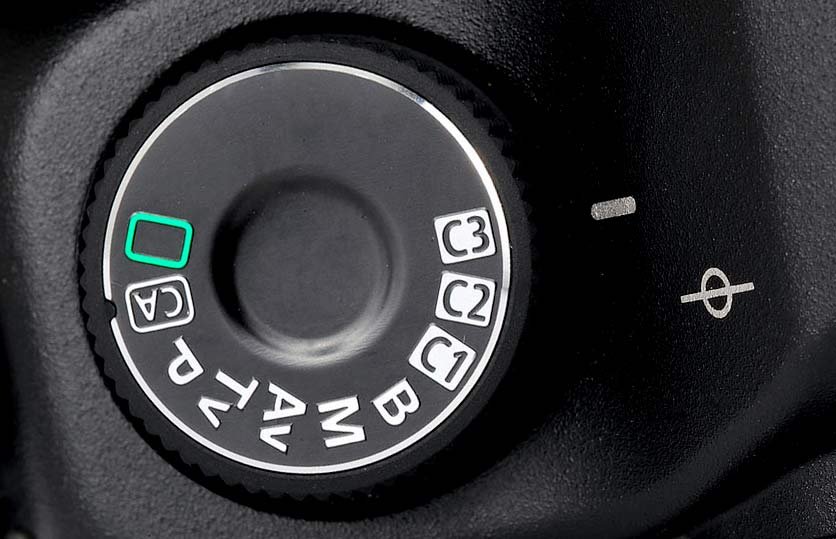
There’s no single button but it’s all part of the meter mode button. If you need a fast way of switching between spot metering and standard metering then consider setting up a custom profile of the mode dial. EG set C3 as spot and C2 as standard.


Retro Cross Polarisation Effect

80s-Mix2Here in the UK we’re in the full grip of Autumn and all the wonderful photo opportunities that this time of year brings. Sadly the amazing colours of autumn are usually a fleeting thing with wind and rain making the chances of capturing them even more challenging.

So here’s a brilliant idea that you can do any time of year and whatever the weather.

The techique makes use of cross polarisation. It’s one of the very first tricks I learnt way back in the mid 80’s when I first became serious about photography. All you need is an LCD screen as your light source, something made of clear plastic and a polarising filter for your camera. I’d also recommend a tripod to minimise camera shake or high ISO noise.

To finish off I added a texture and as I mention in the video I’m sharing it. To download it just follow this link http://adobe.ly/1ac4x7M click the Actions button and choose to download the JPG image.

[youtube]http://www.youtube.com/watch?v=AG3F4gG3tuw&feature=c4-overview&list=UU8Pksdbj37CdE00kmE7Z1dw[/youtube]

Coastal 15 minute photo challenge

I know there are a lot of photographers out there who enjoy my 15 minute photo challenge videos, including me. Although I don’t get the chance to make as many as I once did they’re certainly not consigned to the history book… far from it.

If you’re new to my blog then you may be wondering what a fifteen minute photo challenge is. Basically its my way of sharpening my camera skills and training my photographers eye but limiting myself to a fixed amount of shooting time. Not only that but I’m also restricting the geographic area in which I can look for photos which can be a blessing and a curse. The end result is often unpredictable and always challenging, it often takes me out of my comfort zone which is always a good thing to do every once in a while.

Keep scrolling down to see a few of the final photos.

[youtube]http://www.youtube.com/watch?v=gFU4SSEjYVs[/youtube]
Can’t see the video? Click Here http://www.youtube.com/watch?v=gFU4SSEjYVs

Saltdean-1

Saltdean-2

Saltdean-3

Equipment used in the video:

Adobe Photoshop CC
http://www.adorama.com/ABPSCS6W.html?KBID=67338

Canon 60D
http://www.adorama.com/ICA60D.html?KBID=67338

Sigma 10mm-20mm
http://www.adorama.com/SG1020EOS.html?KBID=67338

Sigma 10mm-20mm
http://www.adorama.com/BRRS7.html?KBID=67338

Vanguard ABEO Plus 283CT Tripod
http://www.adorama.com/VGABEO283CT.html?KBID=67338

Vanguard GH-200 head
http://www.adorama.com/VGGH200.html?KBID=67338


Backlit portrait with just one light

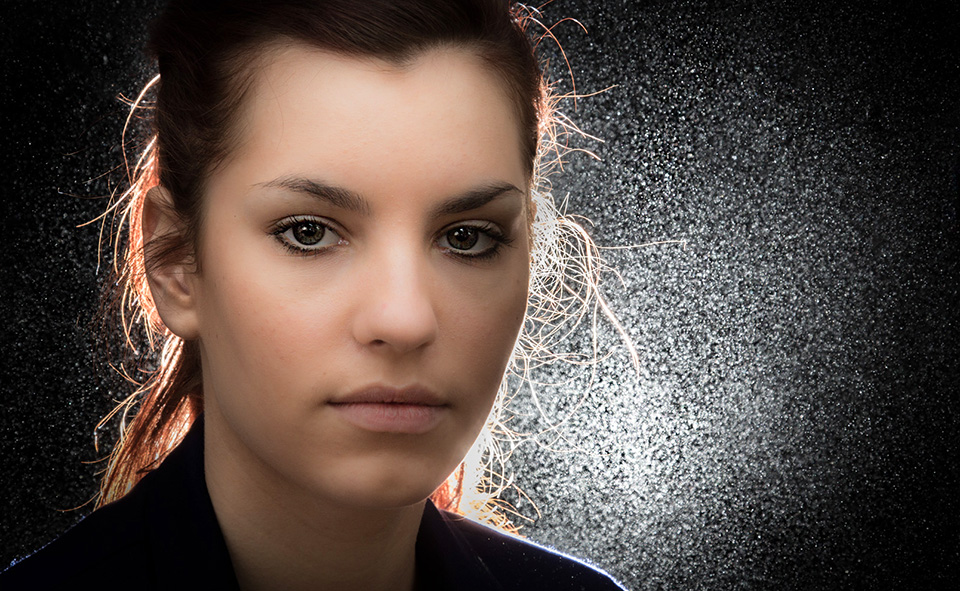
Final-ChristinaI’m a huge fan of using speedlights, or flash guns as I grew up calling them and I know a lot of photographers own at least one. For me the humble speedlight is a powerful tool capable of producing amazing portraits.

In this video I try to break the laws of physics by using one speedlight to light both the back and front of a model with just one light. The secret is reflecting the light off of a silver reflector which in effect makes one light become two.

As a final touch I’ll create a sparkling background by adding a little bit of flour into the air behind my model Kristina but in front of the flash.
[youtube]http://youtu.be/p3xCN7geBI0[/youtube]

Equipment used in the video: 

Adobe Photoshop CS6

http://www.adorama.com/searchsite/default.aspx?searchinfo=photoshop+cs6&category=4294967278+11&KBID=67338

Canon 60D

http://www.adorama.com/ICA60D.html?KBID=67338

Canon 24-105L f/4 IS
http://www.adorama.com/CA24105AFU.html?KBID=67338

5 in 1 reflector
http://www.adorama.com/WE5I1R20.html?KBID=67338

Shooting Ice Hockey for the first time

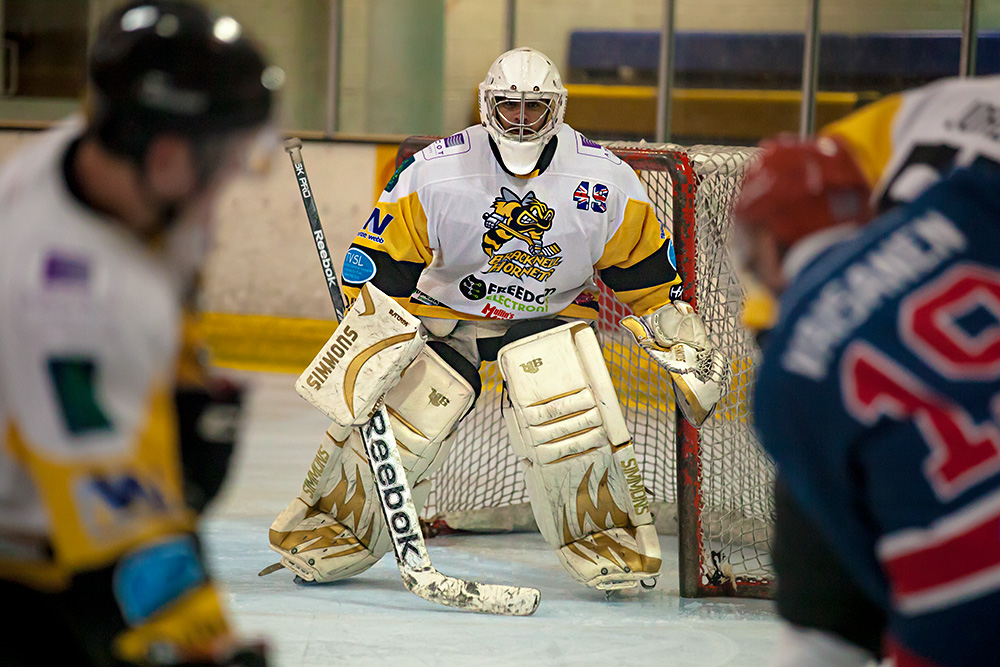
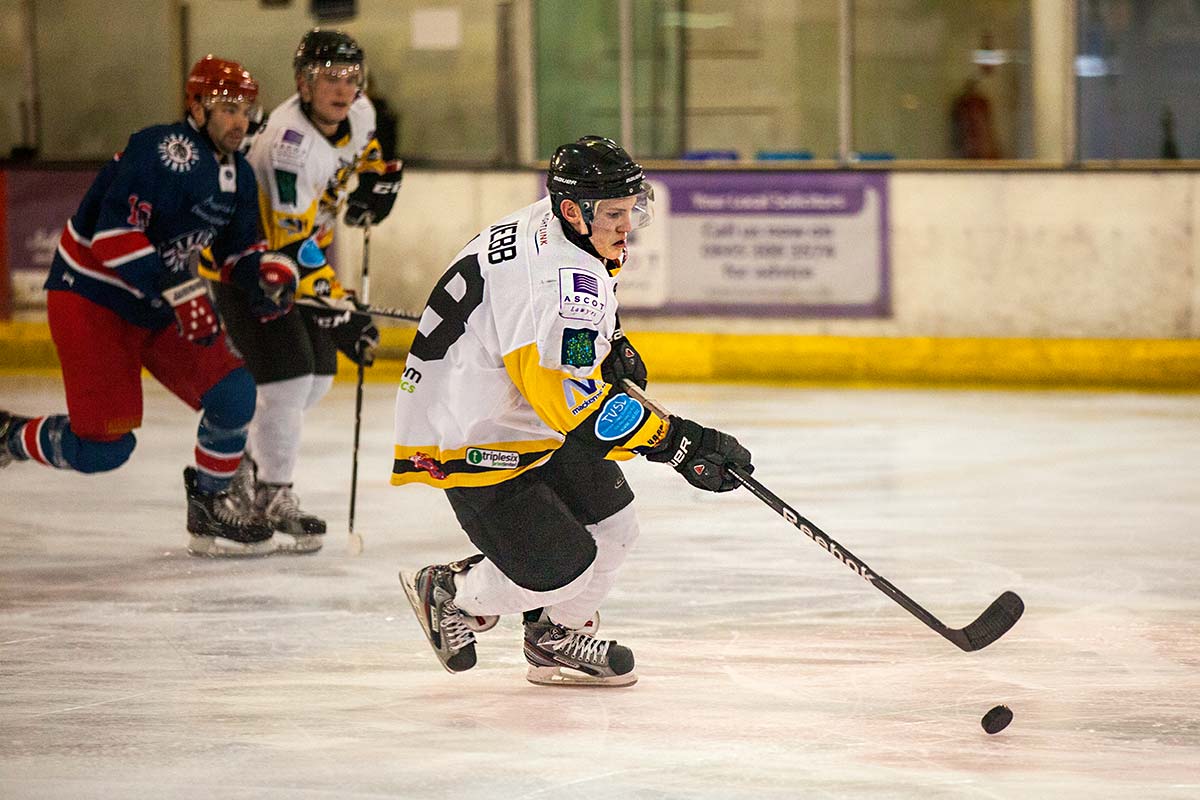
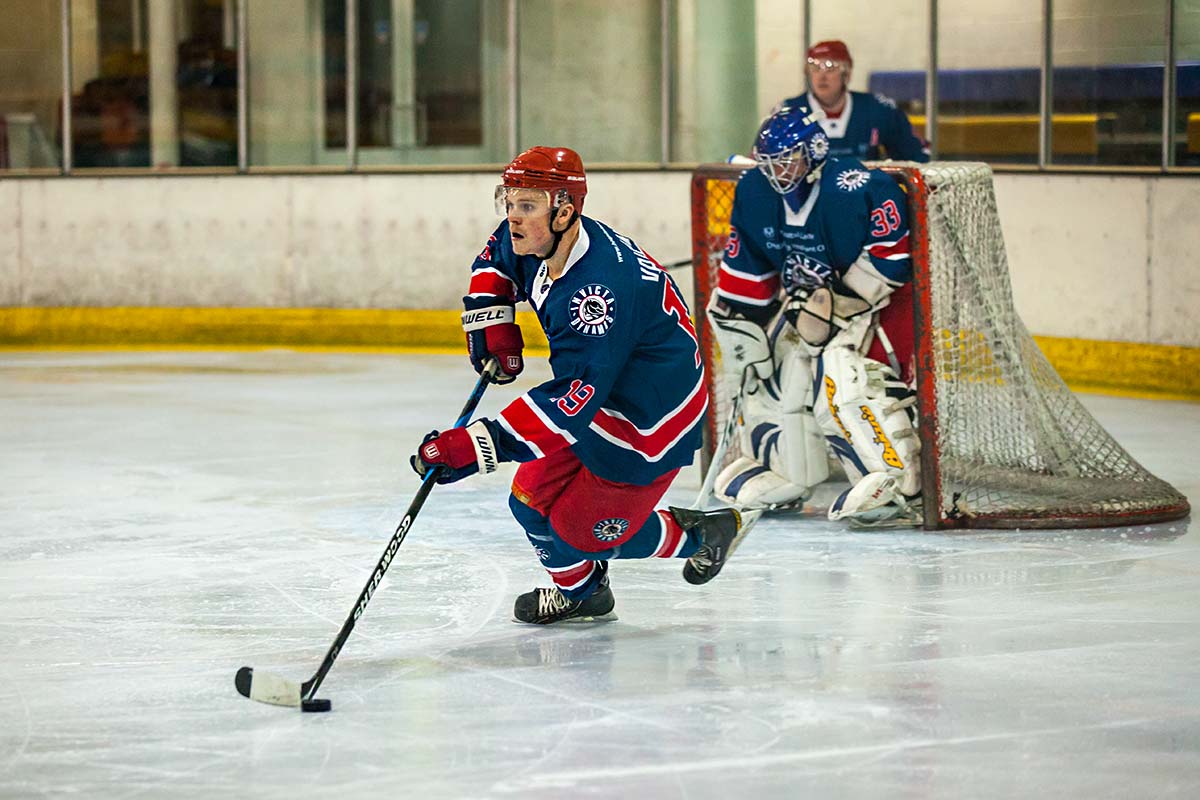
I really do love shooting sport but it’s not something I get the chance to do very often, so when I got an invite from Kevin Slyfield to shoot an ice hockey match I jumped at the chance. Kevin is the official team photographer for the Bracknell Hornets and is an excellent sports shooter as you can see from his Flicker page. 

hornets-1Ice hockey is a sport I’ve never watched, let alone shot but in the past I’ve seen some amazing photos taken by my North American friends. I’ve also heard them say it’s one of the hardest sports to shoot due to its fast pace, low light and the need to shoot through Perspex.

I did a fair bit of research before the game which included getting a very basic idea of the rules of hockey. I concluded the rules were bendable but generally included a brawl at some point. More usefully I opted to shoot with my Canon 70-200 f/2.8 IS lens which proved to the perfect choice for the night.

When it came to camera bodies I had a choice of Canon 60D or Canon 5D Mark 2. The 60D offered faster burst shooting and longer reach with my zoom but the 5D2 has the best performance at high ISO’s. In the end I took both but used the 5D2.

In some parts of the world such as North America, ice hockey (or just hockey as it is often called) is a national past time. Huge purpose built rinks which seat 1000’s of spectators are packed to the roof with screaming fans. Sadly ice hockey in the UK doesn’t enjoy even a fraction of that support.

Even though I was shooting a minor league match I did expect a bigger crowd, which probably numbered less then 100 people. Fortunately both teams took things very seriously and it was clearly a competitive match. hornets-2

When it came to shooting at the rink I had two options. Shoot through the grubby, scuffed up Perspex or go up to the balcony level and shoot over it. For the first period I took Kevin’s advice and shot from the balcony. From there I was pretty much guaranteed good photos but for me they lacked a certain drama that I wanted to capture.

hornets-3

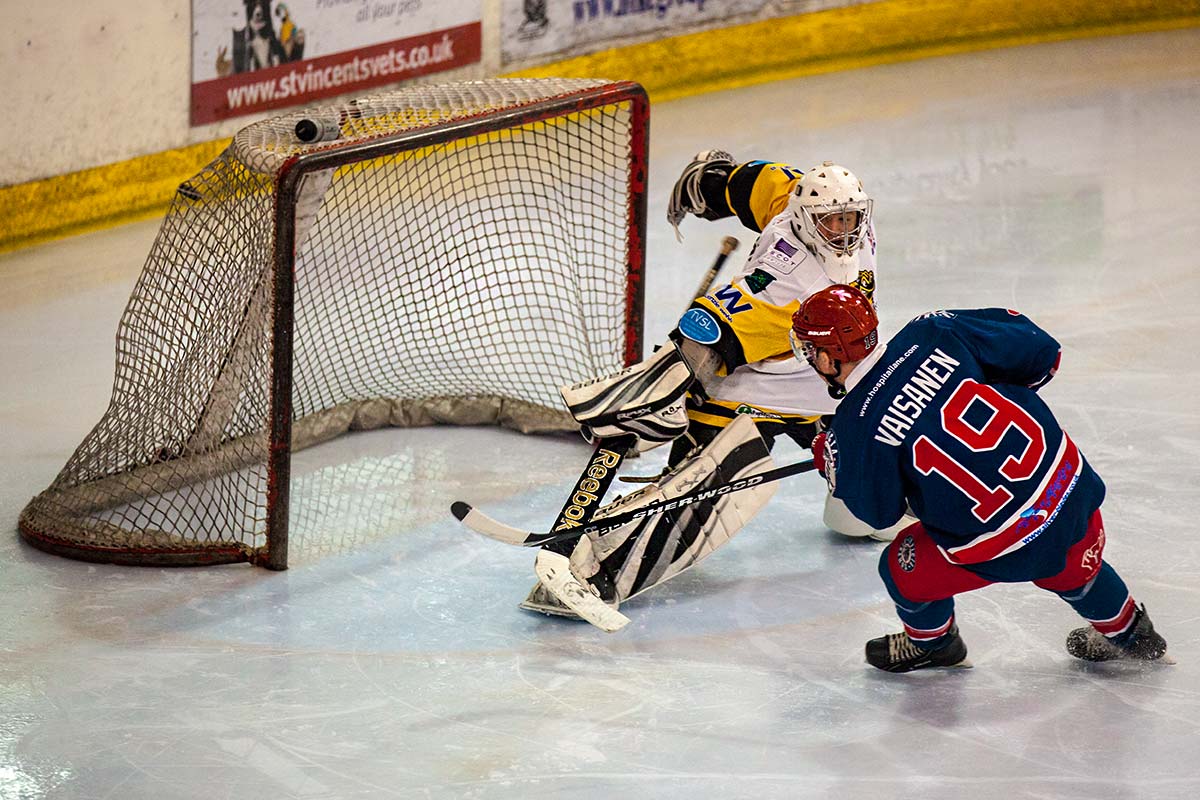
For the second and third periods I opted to shoot rink side through the Plexiglas but finding a clear spot was impossible and although I could clean my side of the glass the rink side was covered in scuffs and marks. Eventually I found a bit that was marginally less damaged then the rest and shot from there. Even so shooting at an angle through the Plexiglas was pointless so I waited for the action to come my way.

If, like Kevin, I needed to record the match I’d recommended shooting over the barrier but when the action came my way you can’t beat being at rink side.

For settings I shot in manual mode as the lighting was constant and even, although there wasn’t much of it. After a bit of trial and error I settled on 1/640th sec, f/2.8 at ISO 4000.

hornets-4

The Canon 5D mark 2 isn’t well known as a speedy focusing camera but sticking to the centre only focusing and continuous focusing with AI Servo it seemed to do surprisingly well all things considered.

By the end of the game I’d really got into the swing of ice hockey and I can see why people love watching the sport and why everyone told me it’s one of the hardest to photograph well.

For the record the final score was Bracknell 2, Invicta 5

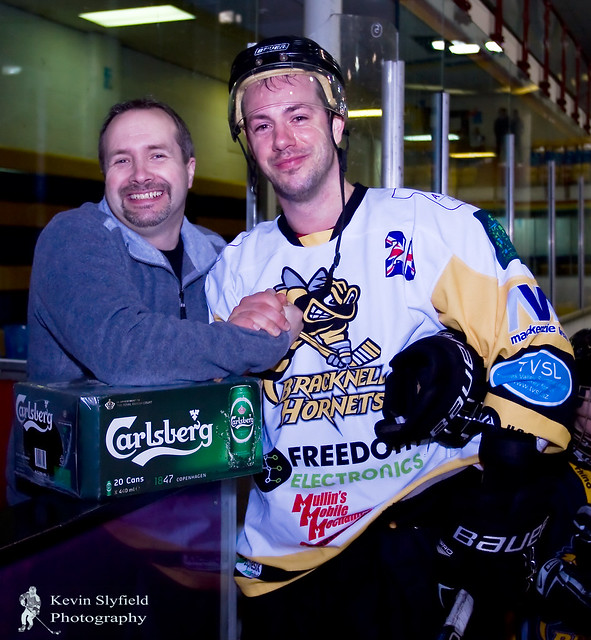
Kevin had one last surprise for me… I got to hand out the runners up prize (a box of beers) to the losing team.